What was Mars like billions of years ago? This is what a recent study published in Communications Earth & Environment hopes to address as an international team of scientists investigated intriguing evidence from the surface of Mars that could indicate heavy water activity existed long ago. This study has the potential to help scientists better understand ancient conditions on Mars and whether they were favorable for supporting life as we know it.
For the study, the researchers examined aluminum-rich rock fragments that were discovered by NASA’s Perseverance rover within Jezero Crater on Mars, and specifically the processes how they formed. This is because aluminum-rich clay minerals on Earth often form from heavy rainfall or other water-driven activities. Using the rover’s SuperCam and Mastcam-Z instruments, the researchers discovered the fragments—which were composed of aluminum and titanium with depleted traces of iron and magnesium—likely were analogs for heavy rainfall on Earth under greenhouse conditions. Therefore, the researchers concluded they potentially formed under intense wet conditions on Mars.
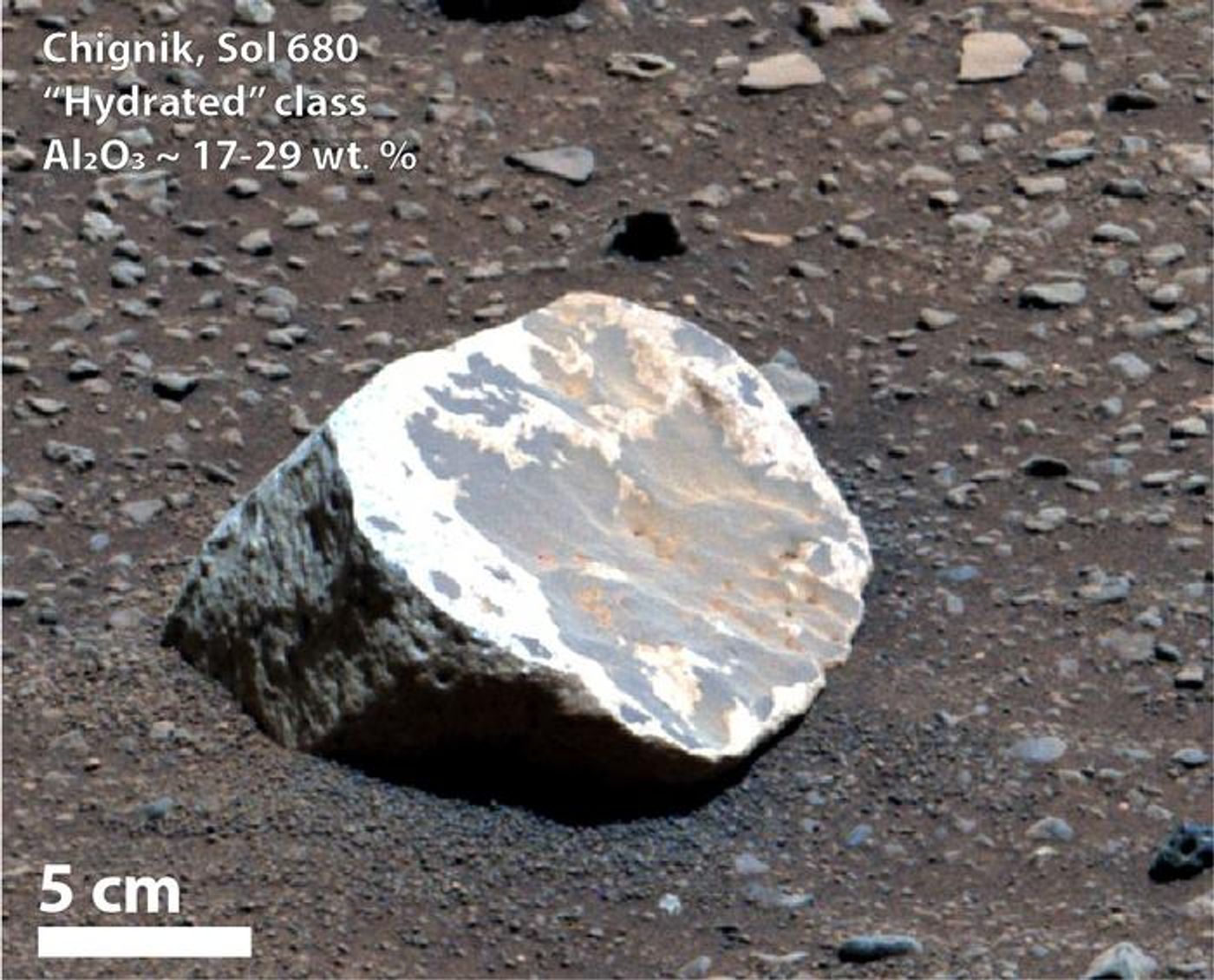
Image of one of the rocks examined by the Perseverance rover for the study. (Credit: NSSA)
“Elsewhere on Mars, rocks like these are probably some of the most important outcrops we’ve seen from orbit because they are just so hard to form,” said Dr. Briony Horgan, who is a Professor of Planetary Science at Purdue University and a co-author on the study. “You need so much water that we think these could be evidence of an ancient warmer and wetter climate where there was rain falling for millions of years.”
Billions of years ago, scientists hypothesize that Mars was a much warmer and wetter place, with cascading rivers and flowing seas of liquid water that covered much of the planet’s surface. However, something catastrophic happened that caused all of the water to disappear into space. Now, scientists are using evidence obtained from orbital images and rover analyses to piece together past events that caused Mars to go from wet to dry.
What new insight into ancient Mars water will researchers make in the coming years and decades? Only time will tell, and this is why we science!
As always, keep doing science & keep looking up!
Sources: Communications Earth & Environment, EurekAlert!