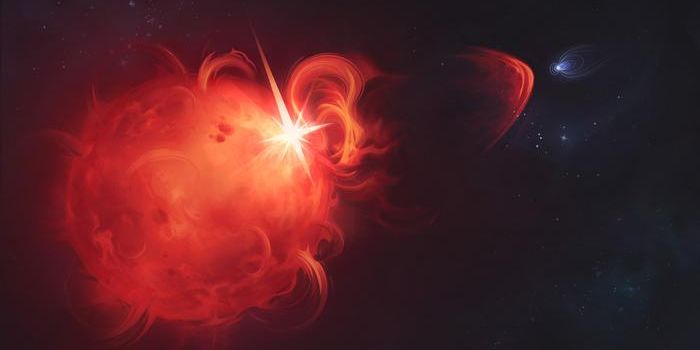
What can imaging supernovae (plural for supernova) explosions teach astronomers about their behavior and physical characteristics? This is what a recent study published in Nature Astronomy hopes to address as an international team of researchers investigated the mechanisms behind the thermonuclear eruptions that supernovae cause. This study has the potential to help scientists better understand supernovae, as they are hypothesized to be responsible for spreading the chemical elements and molecules needed for life throughout the universe.
For the study, the researchers used the Georgia State University CHARA Array to observe exploding supernovae from two separate white dwarfs: nova V1674 Her and nova V1405 Cas, which are located approximately 16,200 and 5,500 light-years from Earth, and were observed days 2 & 3 and days 53, 55, & 67 after first light of eruption, also known as t0, respectively. For nova V1674 Her, the researchers observed outflows during days 2 & 3, while they observed this same behavior for nova V1405 Cas during days 53, 55, & 67. The researchers note these contrasting observations challenge longstanding hypotheses regarding supernovae behavior during their eruption periods.
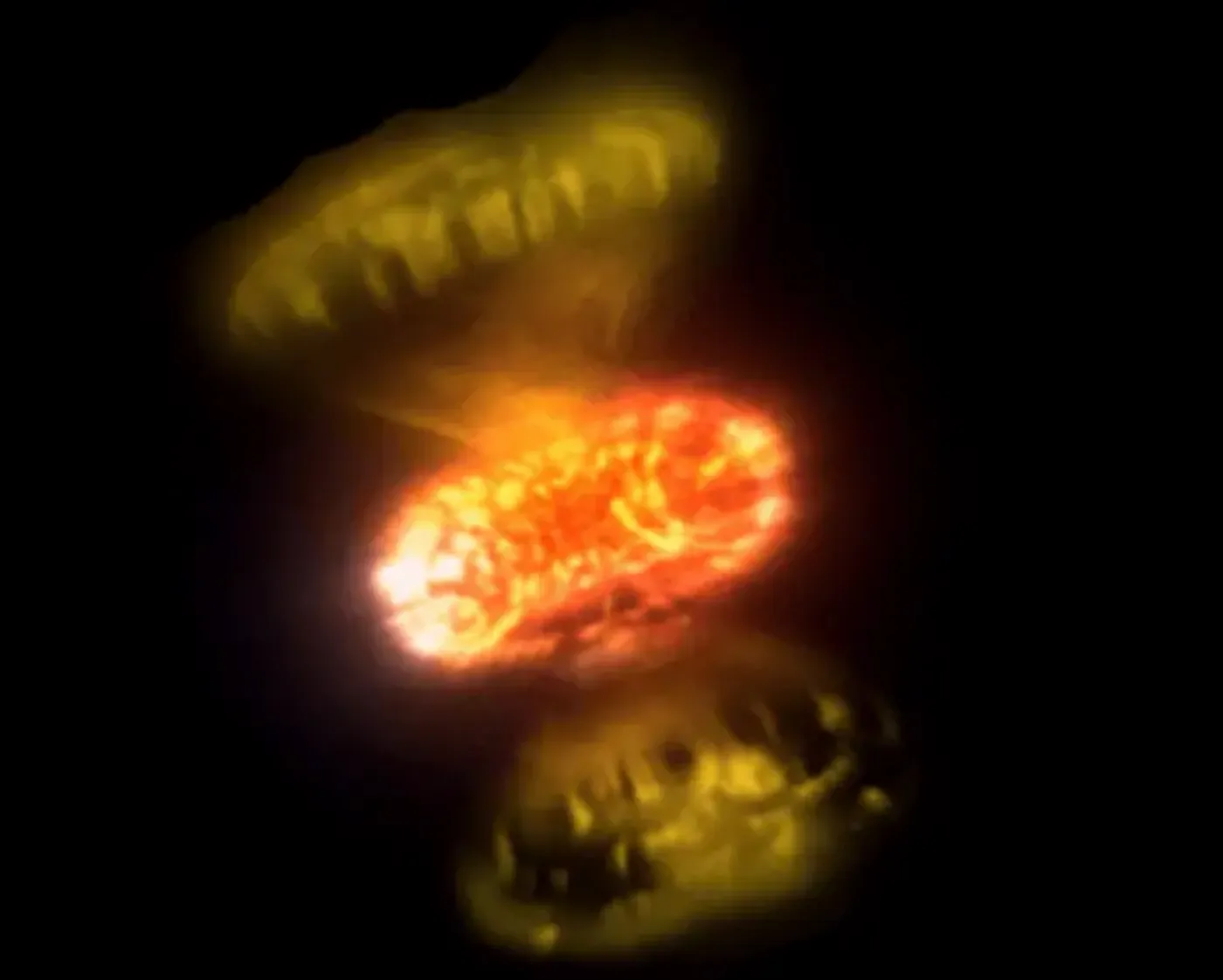
Artist's illustration of nova V1674 Her. (Credit: The CHARA Array)
“Novae are more than fireworks in our galaxy — they are laboratories for extreme physics,” said Dr. Laura Chomiuk, who is a Professor in the Department of Physics & Astronomy at Michigan State University and a co-author on the study. “By seeing how and when the material is ejected, we can finally connect the dots between the nuclear reactions on the star’s surface, the geometry of the ejected material and the high-energy radiation we detect from space.”
Going forward, the researchers aspire to obtain more images of supernovae with the goal of better understanding the lifetime of stars and what this could mean for finding life beyond Earth.
What new insight into supernovae will researchers make in the coming years and decades? Only time will tell, and this is why we science!
As always, keep doing science & keep looking up!
Sources: Nature Astronomy, EurekAlert!