How many exoplanets orbit two stars? This is what a recent study published in The Astrophysical Journal Letters hopes to address as a team of scientists announced the discovery of a new exoplanet orbiting in a binary system, or a system with two stars. This study has the potential to help scientists better understand the formation and evolution of planetary systems and what this could mean for finding life beyond Earth.
For the study, the researchers confirmed the existence of HD 143811 AB b, which is located approximately 446 light-years from Earth while having an estimated mass of approximately 5.6 times that of Jupiter. Along with orbiting two stars, HD 143811 AB b is estimated to orbit its parent star at 64 astronomical units (AU), which is 64 times the distance that Earth orbits our Sun while Neptune orbits our Sun at just over 30 AU. Despite its long orbit, the discovery of HD 143811 AB b was due to the direct imaging method, where astronomers blot out the intense glare of a star, revealing the exoplanets that were previously hidden underneath.
“Of the 6,000 exoplanets that we know of, only a very small fraction of them orbit binaries,” said Dr. Jason Wang, who is an assistant professor in the Department of Physics & Astronomy at Northwestern University and a co-author on the study. “Of those, we only have a direct image of a handful of them, meaning we can have an image of the binary and the planet itself. Imaging both the planet and the binary is interesting because it’s the only type of planetary system where we can trace both the orbit of the binary star and the planet in the sky at the same time.”
Due to HD 143811 AB b orbiting two stars, it’s drawing comparisons to Tatooine from Star Wars and the iconic scene with Luke Skywalker looking at the setting of his two suns. Another key aspect is while NASA has confirmed the existence of more than 6,000 exoplanets, only approximately 100 have been confirmed to orbit binary stars, or even greater number of stars.
How many more exoplanets in binary systems will astronomers discover in the coming years and decades? Only time will tell, and this is why we science!
As always, keep doing science & keep looking up!
Sources: The Astrophysical Journal Letters, EurekAlert!
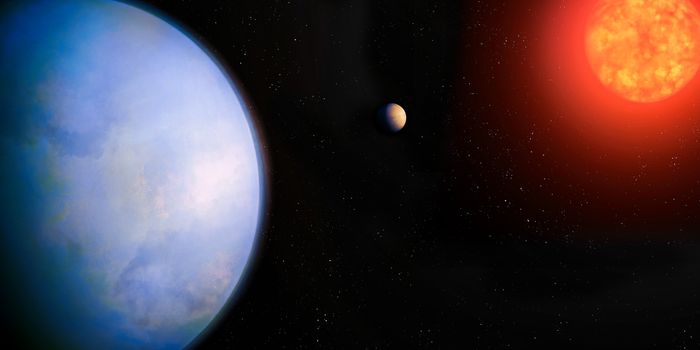
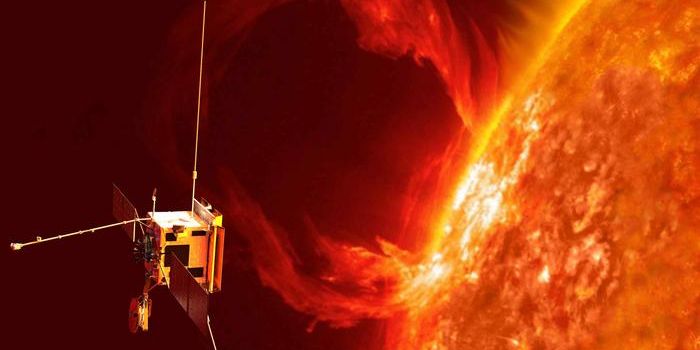
Featured Image: Artist's illustration of an exoplanet orbiting two stars. (Credit: NASA / JPL-Caltech / T.Pyle)