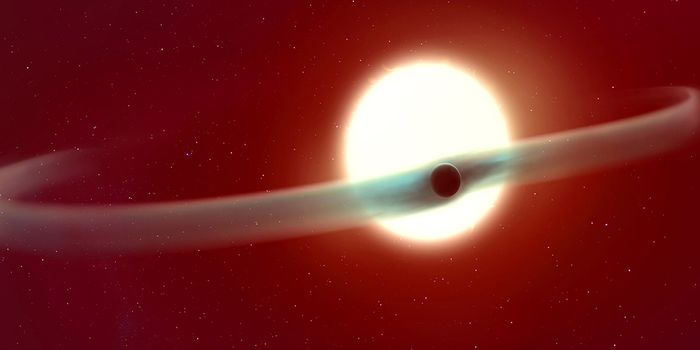
What happens to a large star near the end of its lifetime before it explodes as a supernova? This is what a recent study published in The Astrophysical Journal Letters hopes to address as a team of researchers from the United States, Canada, and Japan investigated the final decade of life for a large star before it goes supernova. This study has the potential to help scientists better understand the evolution of large stars and supernovae, as the latter is responsible for spreading the ingredients of life throughout the universe.
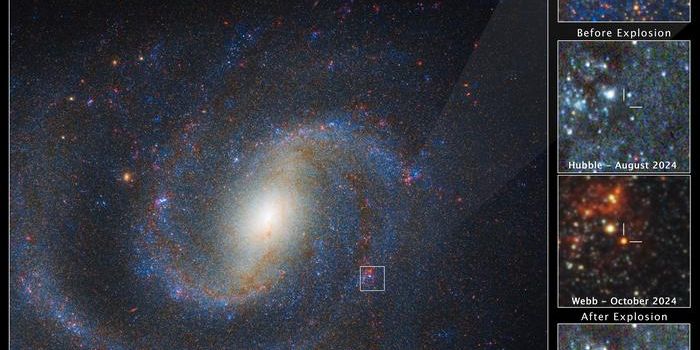
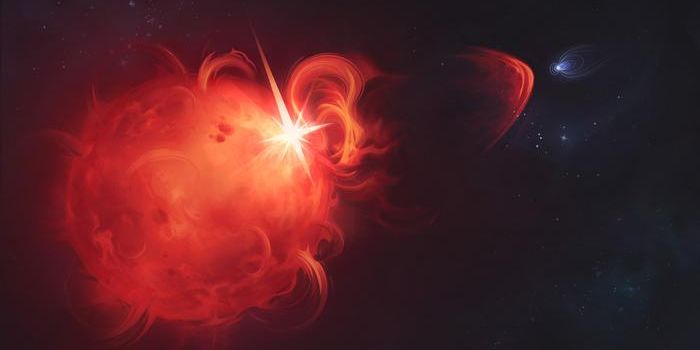
For the study, the researchers conducted the first radio detection of a star near the end of its lifetime that interacts with a hydrogen-poor, helium-rich circumstellar medium, also called Ibn supernovae (SNe Ibn), and occurs when a massive star ejects material before it dies. This particular SNe Ibn is designated as SN 2023fyq, which was discovered in 2023 and is approximately 59 million light-years from Earth. During the 18-month survey, the researchers discovered that SN 2023fyq was ejecting massive amounts of gas only a few years before it went supernova. Essentially, the star exhibited inherent pre-explosion shedding before fully exploding.
“We were able to use radio observations to ‘view’ the final decade of the star’s life before the explosion,” said Raphael Baer-Way, who is a PhD student at the University of Virginia and lead author of the study. “It’s like a time machine into those last important years, especially the final five when the star was losing mass intensely.”
Going forward, the researchers aspire to expand the search by studying more SNe Ibn, thus gaining crucial insights into the formation and evolution of massive stars and the subsequent explosions that come at the end of their lives.
What new insight into the final years of supernovae will researchers make in the coming years and decades? Only time will tell, and this is why we science!
As always, keep doing science & keep looking up!
Sources: The Astrophysical Journal Letters, EurekAlert!