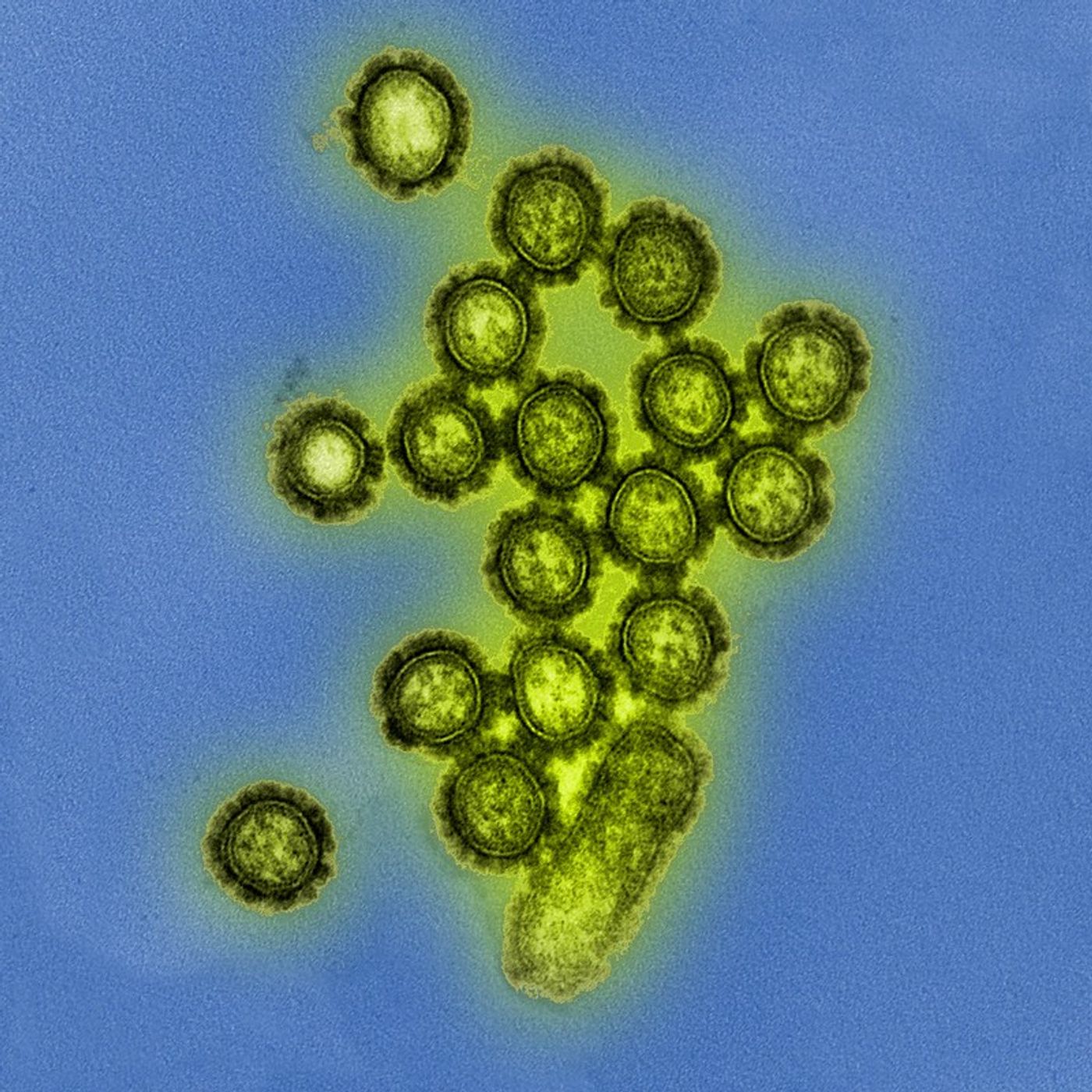
When a pathogen like a dangerous virus invades the human body, it usually has to enter human cells to cause an illness. Influenza has to latch onto a receptor on the surface of a human cell so it can enter that cell and use the cellular machinery to churn out more influenza particles, which can then enter more cells and repeat the process, making us sick. Now scientists have studied the infection process in close detail, and have visualized viral flu particles as they move into cells. The findings have been reported in the Proceedings of the National Academy of Sciences (PNAS).
In this work, the researchers took advantaged of powerful microscopy tools called atomic force microscopy (AFM) and fluorescence microscopy, and combined them to create virus-view dual confocal and AFM (ViViD-AFM). They were able to use this method to actually observe virus particles getting into a live cell, as seen in the video below.
This study revealed that cells don’t sit by passively, they try to capture flu particles. "The infection of our body cells is like a dance between virus and cell," noted senior study author Yohei Yamauchi, Professor of Molecular Medicine at ETH Zurich. This process is a mechanism that cells usually use to take up important stuff like cholesterol or hormones.
Influenza viruses scour cell surfaces to look for an entry point, and attempt to latch onto various receptors. After finding a suitable binding site, the virus attaches itself, and a physical pocket forms there. Eventually, a vesicle shaped in part by a protein called clathrin surrounds the flu particle and takes it into the cell. Once inside, the vesicles releases its contents, which in this case is the flu virus.
Now that the dynamics of an infection have been visually revealed, scientists can see that cells actively promote infection in some ways. The cell, for example, can try to capture the virus by bulging around it. It also directs the clathrin proteins to the virus’s binding site so that a vesicle will form.
Now this technique can be used to analyze the dynamics of other infections, the researchers suggested.
Experienced research scientist and technical expert with authorships on over 30 peer-reviewed publications, traveler to over 70 countries, published photographer and internationally-exhibited painter, volunteer trained in disaster-response, CPR and DV counseling.