
Professor, Department of Obstetrics and Gynaecology ; Deputy Director, Prenatal Genetic Diagnosis Centre, CUHK; Director, Pre-implantation Genetic Diagnosis Laboratory, CUHK
BIOGRAPHY

Date & Time
Date: April 22, 2021
Time: 10:00am (CEST), 4:00pm (CST)
Abstract
Advancements in technologies have revolutionized the genetic landscape. Chromosomal microarray analysis (CMA) becomes a proven method and is implemented to detect gains and losses of DNA and absence of heterozygosity across the genome. Next-generation sequencing technologies have brought opportunities and challenges to genetic testing, its prenatal application is an emerging field. We describe our experience using FetalChip, a CMA for prenatal research developed in our laboratory and describe the role of CMA in the era of genome sequencing.
Learning Objectives
- The role of chromosomal microarray analysis (CMA) in prenatal genetic clinical research.
- CMA is a well-established and proven technology to identify pathogenic CNVs
- The utility of genome sequencing
For Research Use Only. Not for use in diagnostic procedures.
Webinars will be available for unlimited on-demand viewing after live event.
You May Also Like
FEB 18, 2026 | 1:00 PM

LIVE NOW!
Energy-efficient filtration solutions that reduce hidden chemical exposure from benchtop work and lab equipment to improve overall laboratory safety...
FEB 18, 2026 | 8:00 AM

With advancing food allergy research and emerging therapies, new allergy testing requirements arise. In this context, Basophil Activation Testing (BAT) has emerged as an essential component...
FEB 19, 2026 | 7:00 AM

Discover how Iconeus One, the premier functional ultrasound (fUS) system for neuroscientists, is transforming brain function studies. Based on ultrafast plane-wave sonography, Iconeus One of...
FEB 19, 2026 | 8:00 AM
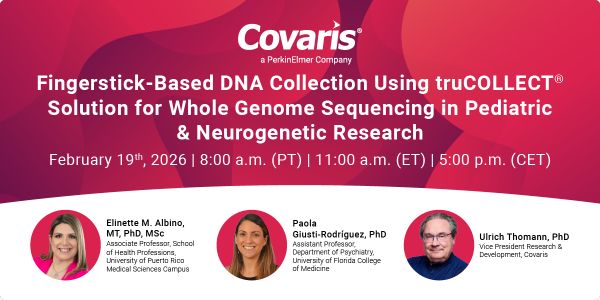
The collection of high-quality genomic DNA remains a major barrier in pediatric and neurodevelopmental research, particularly among children with autism spectrum disorder (ASD) and other neu...
FEB 23, 2026 | 9:00 AM
C.E. CREDITS

Explore decentralized liquid biopsy with SOPHiA GENETICS and MSK-ACCESS®, expanding access, improving outcomes, and accelerating precision oncology....
FEB 23, 2026 11:00 AM PT / 2:00 PM ET / 8:00 PM CET

The timing of the biological onset of multiple sclerosis (MS) is unclear. We used high-throughput discovery proteomics and samples from presymptomatic patients with MS and matched healthy co...
Loading Comments...