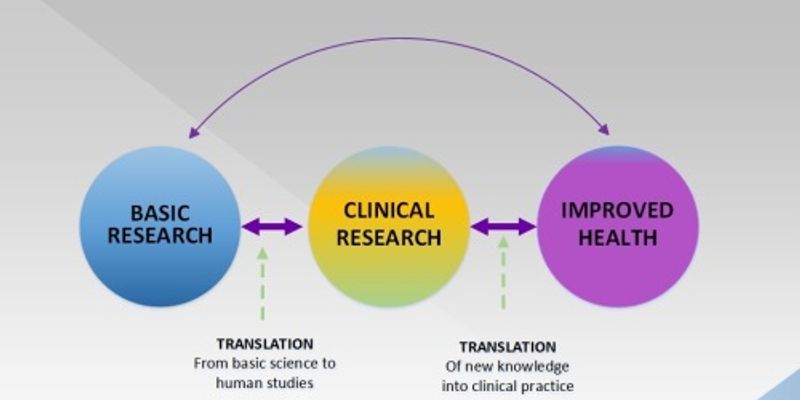
Translational Research: involves the application of knowledge gained through basic research to studies that could support the development of new products. For example, translational research in the field of medicine may involve using knowledge of the biology of a disease to identify and evaluate chemical compounds in disease models, with a view to selecting potential candidate drugs to advance into clinical trials.
The management of prostate cancer (PCa) continues to evolve and does so at a rapid rate. Research and technological developments continue to refine our definitions and management of this comp...
The process by which observations in the laboratory or the clinic are transformed into demonstrably useful interventions that tangibly improve human health is frequently termed "translation."...
Learning Objectives for this presentation -
(1) Understand how human genetics can contribute to drug discovery and development.
(2) Understand the role of biomarkers and clinical proof-...
The webinar will start at 4am Pacific Time, 7am Eastern Time, 1pm Central European Summer Time, 7pm China Standard Time
Extracellular vesicles (EVs) including exosome and microvesi...
Next-generation sequencing (NGS) technologies are powerful approaches for diagnosis and surveillance of emerging infections. Unbiased metagenomic NGS can detect the full spectrum of pathogen...
Polyamines are small, mostly linear organic molecules found in almost all living cells, and are positively charged at physiological pH. As a consequence of their positive charge, polyamines b...
Among many surprising insights, the genomic revolution has helped us to realize that we're never alone and, in fact, barely human. For most of our lives, we share our bodies with some ten ti...
DATE: July 22, 2015TIME: 9:00AM PT, 12:00PM ETHuman induced pluripotent stem cells (iPSCs) bring human biology into pre-clinical aspects of drug discovery. iPSC-derived cardiomyocytes have em...
Exosomes are small secreted vesicles that have a diameter of ~50-200 nm. Exosomes are enriched for a specific subset of host-derived proteins, nucleic acids, lipids and carbohydrates, though ...
The emerging field of RNA nanotechnology has led to the utilization of the platform in the field of bionanotechnology as sensing platforms, diverse nanoparticle construction, in vivo computin...
Date: Wednesday, June 24th, 2015 Time: 09:00AM PDT, 12:00PM EDT, 4:00PM GMT Solaris™ is a new open-air fluorescence imaging system developed by PerkinElmer, enabling translational in vivo pre...
DATE: June 17th, 2015TIME: 8am Pacific time, 11am Eastern timeSpatial heterogeneity of tumors has been identified within and between metastatic lesions and can be visualized wit...
Consistent accuracy in reporting quantitative viral load results is critically important to patients, their physicians and to the clinical laboratory. In clinical practice, quantitative viral...
Date: Thursday, June 11th, 2015Time: 07:00AM PDT, 10:00AM EDT, 03:00PM BST Alzheimer's disease (AD) is the most common form of dementia with nearly 44 million people affected worldwide. Chara...
Matching the mutational profile of a patient's tumor with appropriate targeted agents is a goal of personalized medicine in oncology. The number of FDA-approved targeted therapies, as well as...
DATE: Tuesday, May 26th, 2015TIME: 09:00AM PDT, 12:00PM EDTNext-generation sequencing (NGS) is changing the landscape of clinical research. This powerful technology is enabling researchers to...
With current NGS platforms, the boundaries of variant detection and gene content for genetic disease panels has been vastly expanded leading to increases in detection rates. However these pla...
Over the past few years, evidence has been accumulating to indicate that ribosomal subunits are not simply tape-heads that decode mRNA sequences into polypeptide chains, but that they also pl...
Cancer is complex, but recent findings are yielding a greater understanding of the disease. The tumor suppressor genes BRCA1 and BRCA2 are implicated in breast, ovarian, prostate, and other c...
Biological datasets have become increasing large and complex. Knowledge databases and publicly available datasets are available for use in experimental planning and running results comparison...
I will discuss recent statistical methods for identifying differentially expressed genes in static and time course bulk RNA-seq experiments. I will also provide an overview of the opportunit...
The hippocampal formation is one of the most extensively studied regions of the brain, with well described anatomy and basic physiology; moreover, aspects of human memory mediated by hippocam...
Schizophrenia is a severe psychiatric disorder affecting 1% of the world’s population, leading to high human, social and economic burdens. Understanding how the interaction of gene and...
The management of prostate cancer (PCa) continues to evolve and does so at a rapid rate. Research and technological developments continue to refine our definitions and management of this comp...
The process by which observations in the laboratory or the clinic are transformed into demonstrably useful interventions that tangibly improve human health is frequently termed "translation."...
Learning Objectives for this presentation -
(1) Understand how human genetics can contribute to drug discovery and development.
(2) Understand the role of biomarkers and clinical proof-...
The webinar will start at 4am Pacific Time, 7am Eastern Time, 1pm Central European Summer Time, 7pm China Standard Time
Extracellular vesicles (EVs) including exosome and microvesi...
Next-generation sequencing (NGS) technologies are powerful approaches for diagnosis and surveillance of emerging infections. Unbiased metagenomic NGS can detect the full spectrum of pathogen...
Polyamines are small, mostly linear organic molecules found in almost all living cells, and are positively charged at physiological pH. As a consequence of their positive charge, polyamines b...
Among many surprising insights, the genomic revolution has helped us to realize that we're never alone and, in fact, barely human. For most of our lives, we share our bodies with some ten ti...
DATE: July 22, 2015TIME: 9:00AM PT, 12:00PM ETHuman induced pluripotent stem cells (iPSCs) bring human biology into pre-clinical aspects of drug discovery. iPSC-derived cardiomyocytes have em...
Exosomes are small secreted vesicles that have a diameter of ~50-200 nm. Exosomes are enriched for a specific subset of host-derived proteins, nucleic acids, lipids and carbohydrates, though ...
The emerging field of RNA nanotechnology has led to the utilization of the platform in the field of bionanotechnology as sensing platforms, diverse nanoparticle construction, in vivo computin...
Date: Wednesday, June 24th, 2015 Time: 09:00AM PDT, 12:00PM EDT, 4:00PM GMT Solaris™ is a new open-air fluorescence imaging system developed by PerkinElmer, enabling translational in vivo pre...
DATE: June 17th, 2015TIME: 8am Pacific time, 11am Eastern timeSpatial heterogeneity of tumors has been identified within and between metastatic lesions and can be visualized wit...
Consistent accuracy in reporting quantitative viral load results is critically important to patients, their physicians and to the clinical laboratory. In clinical practice, quantitative viral...
Date: Thursday, June 11th, 2015Time: 07:00AM PDT, 10:00AM EDT, 03:00PM BST Alzheimer's disease (AD) is the most common form of dementia with nearly 44 million people affected worldwide. Chara...
Matching the mutational profile of a patient's tumor with appropriate targeted agents is a goal of personalized medicine in oncology. The number of FDA-approved targeted therapies, as well as...
DATE: Tuesday, May 26th, 2015TIME: 09:00AM PDT, 12:00PM EDTNext-generation sequencing (NGS) is changing the landscape of clinical research. This powerful technology is enabling researchers to...
With current NGS platforms, the boundaries of variant detection and gene content for genetic disease panels has been vastly expanded leading to increases in detection rates. However these pla...
Over the past few years, evidence has been accumulating to indicate that ribosomal subunits are not simply tape-heads that decode mRNA sequences into polypeptide chains, but that they also pl...
Cancer is complex, but recent findings are yielding a greater understanding of the disease. The tumor suppressor genes BRCA1 and BRCA2 are implicated in breast, ovarian, prostate, and other c...
Biological datasets have become increasing large and complex. Knowledge databases and publicly available datasets are available for use in experimental planning and running results comparison...
I will discuss recent statistical methods for identifying differentially expressed genes in static and time course bulk RNA-seq experiments. I will also provide an overview of the opportunit...
The hippocampal formation is one of the most extensively studied regions of the brain, with well described anatomy and basic physiology; moreover, aspects of human memory mediated by hippocam...
Schizophrenia is a severe psychiatric disorder affecting 1% of the world’s population, leading to high human, social and economic burdens. Understanding how the interaction of gene and...
 Follow